
0 comment Wednesday, July 2, 2014 | admin
 I haven't written for a while because I've got a bee buzzing in my bonnet. What will happen to us once the Federal Reserve stops buying mortgages from Fannie Mae and Freddie Mac at the end of March?
 Not terribly sexy, I know, but my research so far shows, sadly, that it will affect all of us (negatively, it seems) and pretty darn fast.
But . . . the whole thing is complicated -- prepayment and default risks, for instance, and many competing views. I don't want to post on it until I understand it (which, frankly, might be never).
 So I'm checking in to say I'm still here, researching this "stimulus withdrawal" or "reduction in quantitative easing" as the big boys put it.
In the meantime, let's give what brought us here another quick look. Because almost everywhere I look, I see reasonably intelligent people blaming George W. Bush for the subprime crisis and the ensuing meltdown. And it's utter nonsense.
 Good politics don't always make good sense. Still, it seems that if the Democrats repeat something loud enough and long enough, people start to believe it is so.
Many minds much brighter than mine continue to debate the first trigger, why the crisis was so wide-spread, and who (or what) is to blame.
But many economists believe the Federal Reserve's policies, shaped by Chair Alan Greenspan, were a primary cause of the depression we find ourselves in.
 Remember old Alan? Married to Andrea Mitchell of MSNBC? Alan, a pure free-market guy, served as Chairman of the Federal Reserve under Reagan, Clinton, and both of the Bushes. In the early to mid-2000s, he kept interest rates low, making money easy to borrow, and he nixed Brooksley Born's suggestion that derivatives be regulated.
 After Clinton left office, Bush reappointed Greenspan. When he retired, Bush replaced him with Greenspan's protegee, "Helicopter Ben" Bernanke. Obama has kept Bernanke as chairman.
Both Greenspan and Bernanke were free market men, believing the markets would always right themselves, and ferret out fraud and misallocations of resources. Both men, many argue now, were wrong.
Greenspan did finally sound the alarm about Freddie and Fannie in 2005.
So on that bright note, I leave you with this incredible video.
 It's a Congressional hearing from 2004 (back in the go-go days . . . remember them? When housing prices could only go up?). The Republicans were concerned Fannie and Freddie were loaning too loosely and that they did not have sufficient reserves to cover losses on subprime mortgages.
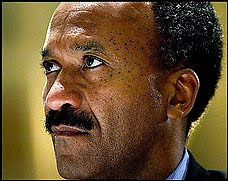 In response to these concerns, the CEO of Fannie, Franklin Raines, says (and sit down for this one) the loans Fannie issued were "riskless."
Yep, you read that right: riskless. Oy vey.
The video is long, I know (and I'm not endorsing the subtitles), but give it a watch as soon as you can. Bill Clinton makes a cameo appearance at the very end. And then write to tell me that this national, nay global, nightmare rests squarely with Bush and the Republicans.
Labels: Bernanke, Federal Reserve, Greenspan, Mbs, Qe, Raines
0 comment Friday, May 23, 2014 | admin
 Interesting terms like "QE2" and "quantitative easing" are being bandied about these days, used to describe the Federal Reserve's latest move, which is to print another six hundred+ billion dollars and put those dollars into the hands of Wall Street banks and investors.
"Quantitative easing" is just a fancy euphemism for printing money. "QE2" denotes this is the second wave of money printing (remember the first one, for a trillion? and how well that worked?).
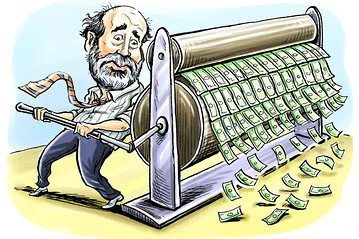
Why print money, you ask? If our country's biggest problem is debt (inevitably followed by higher taxes), why on earth are we incurring more, you may reasonably wonder.
And I don't have an answer for you. It's hard to believe the well-credentialed chairman of the Fed, Ben Bernanke, is doing something so incredibly stupid. But, well, he is.
Here's how his convoluted plan is supposed to work: He'll buy newly-issued Treasury notes from the Treasury and existing Treasury notes from the banks and investors, all with newly printed money. This will keep interest rates low.
Then the banks and investors will use their new found cash to lend to small businesses at crazy low interest rates. Oh, and they'll buy a bunch of stocks with some of their money, too.
 Small businesses, flush with borrowed cash, will create new jobs and hire people. And higher stock prices will make consumers feel grrreat(!) about their 401ks again, spurring them to spend. Remember the "wealth effect"?
And then businesses will hire more people. Stocks will go even higher. Consumers will spend even more! It will be one big virtuous circle! Hooray!
What could go wrong?
First of all, hello? Small businesses don't want to borrow.
 Consumers don't want to borrow or spend.
And at least one smart analyst says the banks will just tuck a good chunk of this money into their reserve accounts because the Fed is paying them interest on their reserves (for the first time in history), and an attractive interest rate at that. (You read that right. The Fed tells banks "lend!" on the one hand and "we'll pay you to hold it" on the other).
 In actuality, banks and investors will take their newly printed money and put it into emerging markets. The thing is, putting money in these foreign markets results in higher prices in those markets, due to increased demand.
 And guess what? These foreign governments don't want higher prices. They're already battling inflation as it is. Not to mention, higher prices in their exports -- think flat screen TVs, hell, lots of other stuff -- will reduce our own country's demand for these goods.
So, surprise, surprise, these foreign governments are hopping mad at the Fed. And if they get super-duper mad, do you think they won't slap high tariffs on our exports to their countries? Can you say "trade wars"?
 A virtuous circle? More like "vicious circle."
All this $600+ billion in quantitative easing instant money will do is devalue our dollar and cause inflation here at home. Again, think flat screen TVs, except now they're prohibitively expensive. Worse, these new Treasury issues will drastically increase our nation's debt.
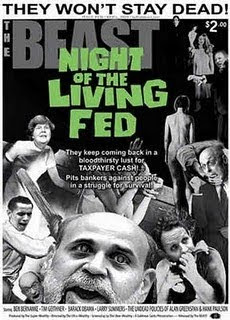 Why, oh why does anyone in Washington think the solution to our debt is to borrow and spend our way out of this recession? Borrowing and spending is what brought us here in the first place.
We need only look to Japan to see how ludicrous is this notion. Give a listen to my econ-hero, Kyle Bass. He pretty much speaks in plain English. (Ignore the basis points stuff -- you'll still get the message. Besides, David Faber is total mind eye candy).